Product · Industrial Intelligence

VitalFusion Edge
The semantic layer for the factory floor.

One model of your plant, served over i3X. PLC tags, MES events and vision detections become a single governed model — so your systems, your people and your physical AI act on the same meaning.

One plant model i3X standard access Physical AI ready Praxis countermeasures
One model
Quality, maintenance, equipment and vision data contextualized against a single plant model
i3X
Factory data published once over the open standard — every consumer inherits it
Physical AI
Work described by capability, not vendor — robots, AGVs and people are interchangeable
Closed loop
Praxis countermeasures carry a record of whether the fix worked
Why it exists

Your plant already streams data. It doesn't stream meaning.

Tag names only a controls engineer can decode. Historian trees that disagree with the MES. Every project re-derives the same plant context by hand. Edge makes that context a governed, queryable asset — kept current from the buses you already run.

One model of the plant

Assets, signals, materials and events modeled once — versioned and governed like code. Ask it questions in plain language, or wire systems to it; every consumer sees the same plant.

i3X enablement of factory data

Plant structure, production, material genealogy, quality and reliability served over the open CESMII i3X standard. Publish once, consume everywhere — no custom integration per system.

Enabling physical AI

Robots, AGVs and people pick up work described by the capability it needs — torque, transport, inspect — not the vendor that supplies it. Factory process logic stays in the model, out of any one fleet system.

Countermeasures & actions — Praxis

Detection alone doesn't fix anything. Praxis raises countermeasures on the same model, dispatches them, and records whether the fix worked.

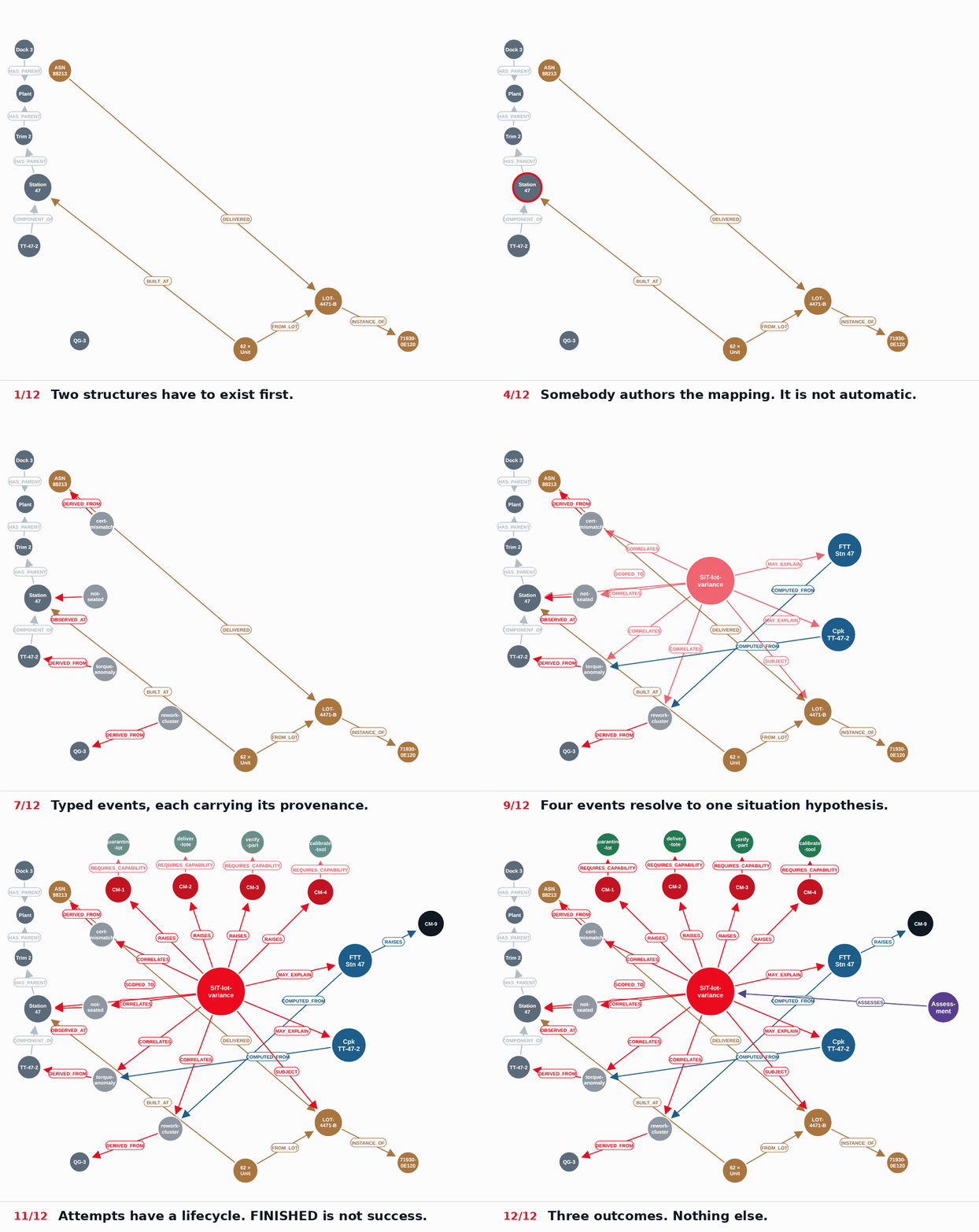
Praxis · walkthrough

From i3X evidence to a traceable countermeasure.

Twelve steps, one thread: context, observations, a named situation, countermeasures, task attempts, an evaluated closure. Payloads illustrative; links explicit.

Animated twelve-step walkthrough: i3X asset and material context builds up into observations, one named situation, countermeasure intents with required capabilities, task attempts, and an evaluated closure.

i3X evidence → situation → countermeasures → evaluated closure

Praxis · Production-Loss Intelligence

Every loss event: what happened, what it cost, why it spread, what fixes it cheapest.

Downtime is charged to the machine that stopped. The plant pays for the loss that propagated. Praxis reconstructs each event across machines, buffers and logistics, prices the propagated loss, and ranks countermeasures by counterfactual — simulated before anyone acts.

praxis · situation record · molding-07 · illustrative
10:31:08Molding 07 faultL1
+03:12Buffer B below safety levelL1
+05:47Cell 4 starved — situation raised, scope widensL2
+08:22Tugger dispatched — countermeasure, capability-addressedL3
+11:04Maintenance arrivesL3
+16:31Molding 07 restarts — resolvingL2
+21:18Downstream recovered — closed, effectiveness computedL2
Machine downtime 16.5 minEffective line loss 21.3 minCost accrued $630 at $1,780/hr
Countermeasure, rankedLoss avoided / eventCostPayback
Tugger schedule −4 min11 min~$0Immediate
+2 buffer positions14 min$8k6 weeks
Additional tugger17 min$90k14 months

Each row is a counterfactual run against the operational twin, not an estimate. Illustrative planning figures — a pilot replaces them with measured ones.

simulation outputdeclared assumptioncomputed dollar

Three kinds of number, kept provably separate. Every dollar traces back to its events and its assumptions.

L0 · Signals

What the plant emits

PLC, robot, conveyor, tugger and andon signals over i3X — raw, not pre-typed.

L1 · Events

What happened

Typed events — cycle, blocked, starved, faulted, changeover, KPI drift — each citing its signal.

L2 · Situations

What it actually cost

A live object per disruption: scope, cascade, propagated loss — not the stopped machine's downtime.

L3 · Countermeasures

What fixes it cheapest

Ranked by counterfactual, dispatched by capability, closed with computed effectiveness.

Level 1 · Data twin

Ships first

PLC, MES, historian and logistics events reconstruct the loss and price it. No 3D required.

Level 2 · Operational twin

Answers "what if"

Queues, buffers, timing, routing, failure distributions — the counterfactual engine under the ranking.

Level 3 · Physical twin

When physics matter

Omniverse / Isaac for robot reach, layout, AMR traffic and synthetic vision. 3D is an engine, not the product.

Pilot metric: recovered production minutes per shift — not model accuracy, not twin fidelity.

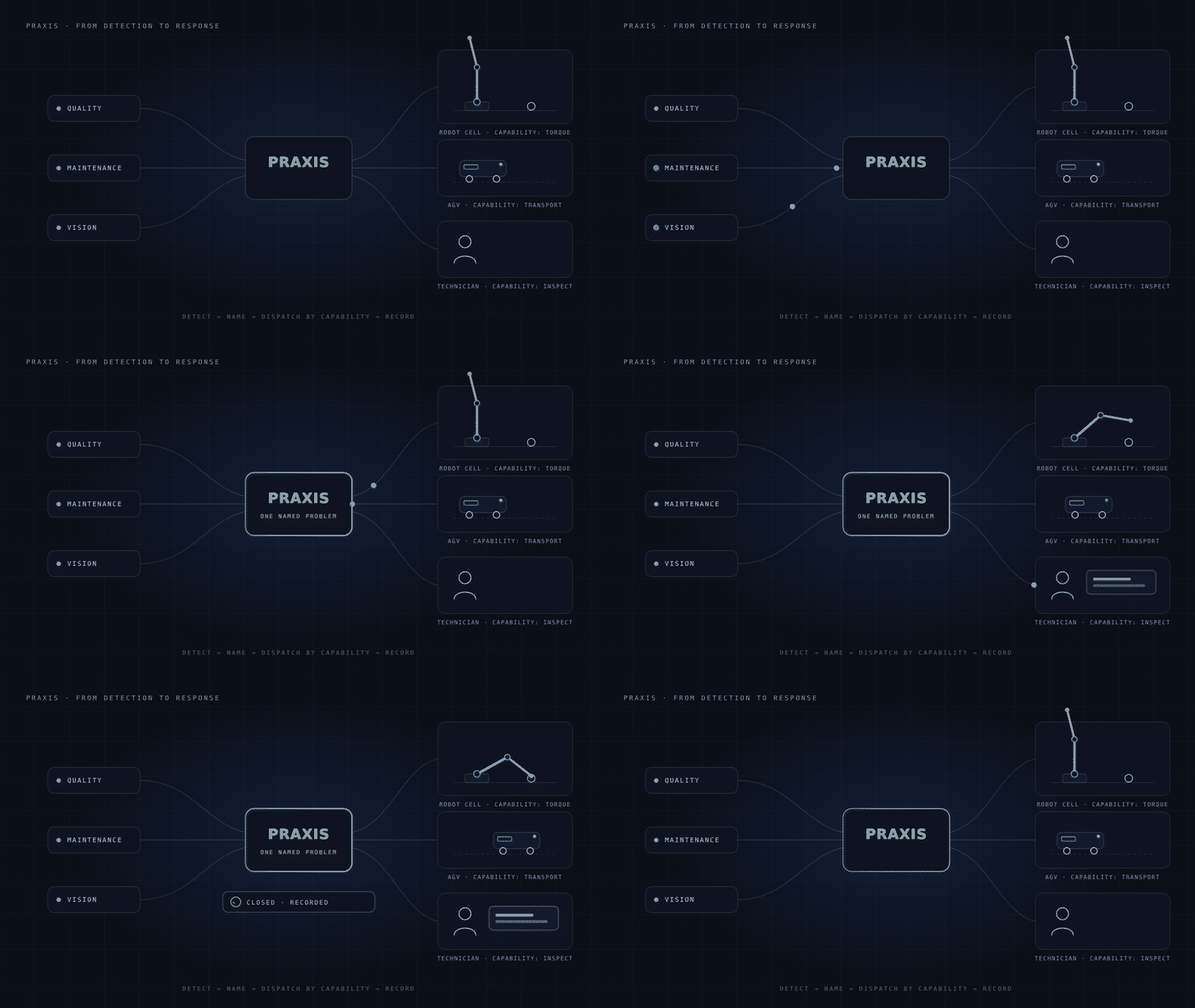
Physical AI

Dispatch by capability.

One named problem; three takers. A robot cell, an AGV and a technician each pick up the piece that matches their capability — and the closure is recorded, whoever did the work.

Animated loop: quality, maintenance and vision signals resolve into one named problem, dispatched by capability to a robot cell, an AGV and a technician, then closed and recorded.

detect → name → dispatch by capability → record

Chat with your factory

Ask the plant why. Out loud, if you like.

Diagnosis without a war room. The assistant reads live signals, walks controller logic upstream, pulls event history and Praxis countermeasures — and shows the reads behind every answer. Illustrative exchange; no live connection.

vitalfusion-edge · plant assistant (concept) · line: Trim 2 · scope: Station 47
You
Why isn't Station 47 cycling right now?
Agent
Station 47 isn't being commanded to cycle — its start request is absent, not faulted.
Live reads: START PERMISSIVE = false · PART AT FIXTURE = true · TOOL TT-47-2 READY = false
What's holding it: the torque controller dropped its ready bit after two over-torque results this shift, and the stop permissive upstream followed. Normal waiting state — clear the tool hold and the start sequence resumes.
live signals · 6 readslogic: start-permissive pathtrace: last 3 cycles
You · voice
What happened here in the last five minutes?
Agent
Two over-torque events on TT-47-2 during WO-8841, both on units from LOT-4471-B. That matches the lot-variance situation Praxis raised this morning — countermeasure verify-part is already queued at gate QG-3. Want the tool recalibration raised as well?
events + material genealogypraxis: situation & countermeasuresanswered at the plant · voice in
Ask about your line — or hold to talk
Deployment · chat with your factory

Three tiers. The plant's data stays in the plant.

Sized by model class and concurrency, not by the model file — KV cache grows with every user and every token of context. We size from lab telemetry before a production bill of materials exists.

Tier 1 · Line-side appliance

Jetson-class, 128 GB unified memory

Machine vision, cycle classification, anomaly detection, sensor inference, local buffering. Sub-second, beside the equipment.

Tier 2 · Shop AI node

Industrial x86 · 24–32 cores · 128 GB ECC · 48 GB-class GPU

Edge Chat, RAG over manuals and drawings, root-cause and starvation agents, semantic layer and knowledge graph, MES/MOM and twin queries — multi-user. Dual 10 GbE, 2–4 TB NVMe, TPM 2.0, secure boot.

Tier 3 · Central / cloud

Your tenancy

Large reasoning models, enterprise search, fleet learning, training, long-horizon analytics. Only embeddings, events and curated clips leave the plant.

What runs on the shop node

Fleet planeZEDEDA / EVE-k · Kubernetes · GPU operator — onboarding, placement, lifecycle, hardware-rooted identity across all three tiers
InferencevLLM · 7B–32B local model · embeddings · reranker
ServicesEdge Chat · agent runtime · RAG · semantic layer · MCP tool gateway
DataVector store · time-series · document store · local cache
OTOPC UA · MQTT · PLC · MES/MOM · andon · digital twin

How we size it

01

Users and model class

Simultaneous plant users, 8B–70B target, and whether line vision shares the box.

02

Lab build

The same stack on two modest machines; CPU, RAM, GPU, IOPS and latency measured under load.

03

Production BOM

Specified from telemetry, not guesses. Never from the fleet plane's minimums.

04

Vendor configurations

Three concrete configurations per line or site — costed in a conversation, not on a web page.

How it works

From tags to a closed loop, four moves.

01 · Model

One plant model

Assets, signals, materials and events modeled once — versioned and governed like code.

02 · Serve

Publish over i3X

Every system and agent consumes the same context through the open standard.

03 · Act

Connect physical AI

Work goes to whoever has the capability — robot, AGV or person, from any vendor.

04 · Close

Record with Praxis

Countermeasures run to an evaluated outcome. The plant learns from what it did.

VitalFusion Edge

See your plant in context — in a 30-minute working session.

Bring one line and one hard question. We'll show you how VitalFusion Edge would model it, and what your team could ask of it.